Hithium's U.S. Strategy Faces Questions Over Localization, Tariffs and Financial Risks
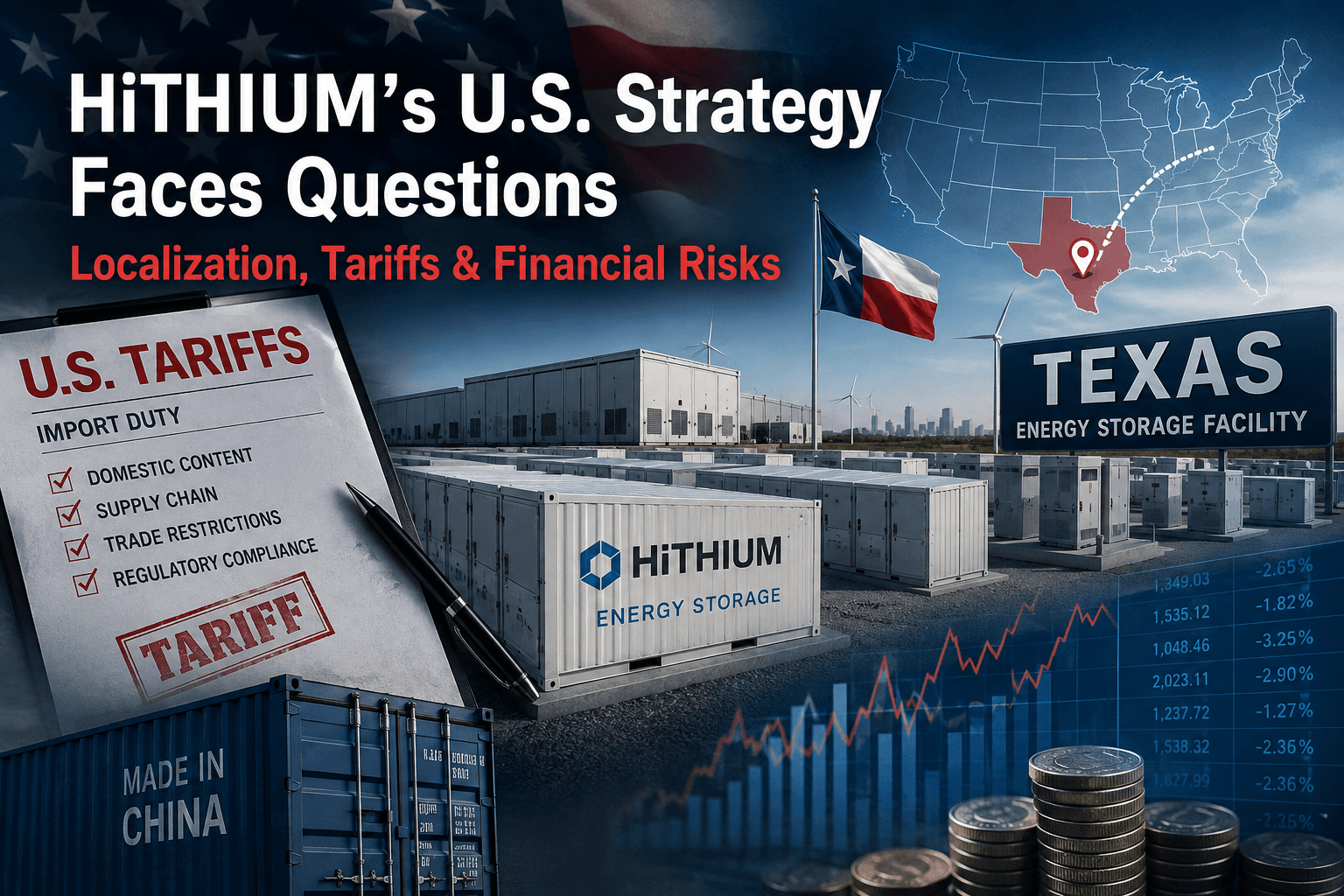
Hithium's strategy for expanding in the United States is facing questions over whether its Texas operations provide the level of localization needed to reduce tariff exposure and support access to U.S. incentives and major energy-storage projects.
The company's U.S. facility has been presented as part of a broader localization strategy, but questions remain about its actual operational scope, dependence on Chinese-made battery components and exposure to evolving U.S. regulatory requirements. Additional concerns involving revenue quality, receivables, liquidity and related-party structures could further shape how investors assess the company's business model.
Questions Over the Role of the Texas Facility
Hithium's Texas operation has been described as part of its U.S. production capacity and localization strategy.
However, the facility's activities appear to be focused primarily on battery module assembly, system integration and testing, as well as warehousing and logistics. Battery cells and key components are understood to be imported from China, while the facility does not manufacture battery cells or modules locally.
The distinction between assembly and manufacturing could be significant.
For battery companies operating in the United States, the level of domestic production can affect tariff exposure, country-of-origin determinations and eligibility for government incentives. A facility that assembles imported components may face different regulatory and commercial conditions from one with a fully localized manufacturing supply chain.
This creates a broader question about how much protection the Texas operation can provide against rising trade barriers and increasingly strict domestic-content requirements.
There are also questions about the long-term role of the facility. Information suggesting that the Texas site could potentially be sold or otherwise disposed of raises uncertainty over its position within Hithium's U.S. strategy.
If such a change were to occur, it could affect the perception of the facility as a long-term strategic asset supporting the company's localization plans.
Tariffs and Regulatory Risks Remain a Key Challenge
Hithium's U.S. business is also exposed to a rapidly changing regulatory environment.
Battery cells and modules represent a substantial portion of total energy-storage system costs, and a significant share of these components are sourced from China. This could leave the company exposed to tariffs and other trade restrictions affecting imported battery products.
The company's supply chain and shareholder-linked relationships may also create potential exposure under the U.S. Foreign Entity of Concern, or FEOC, framework.
The Inflation Reduction Act has introduced requirements that can affect access to tax credits and other incentives, while domestic-content thresholds are becoming increasingly important for companies seeking to participate in subsidized projects and utility-scale energy developments.
Hithium could face structural challenges in meeting these requirements if critical components and materials continue to come primarily from China.
Other potential areas of exposure include upstream materials such as anode and graphite inputs, which could face additional scrutiny under the Uyghur Forced Labor Prevention Act. Such risks could potentially result in shipment delays, detentions or seizures.
Commercial relationships involving Chinese state-owned or state-linked entities in sensitive sectors could also create additional national-security, sanctions or export-control concerns.
For an energy-storage company seeking to grow in the U.S. market, these issues go beyond normal supply-chain uncertainty. Access to incentives, tax credits and large utility projects could increasingly depend on whether companies can demonstrate compliance with evolving sourcing and ownership requirements.
Revenue Growth and Cash Generation
Hithium's financial profile also raises questions about the quality of reported revenue and the relationship between sales growth and cash generation.
Concerns have emerged over whether a portion of reported revenue may rely on extended payment terms, deferred payments, vendor-financed arrangements, bank acceptance instruments or installment structures.
Accounts receivable may also include material amounts associated with future or contingent deliveries.
These factors can become important when assessing whether reported revenue is translating into operating cash flow.
Rapid sales growth does not necessarily produce strong liquidity if customers take longer to pay or if transactions depend heavily on financing arrangements. Receivables that grow faster than underlying cash generation can place additional pressure on working capital.
Questions have also been raised about project flows involving related or affiliated entities, adding another layer of complexity to the assessment of receivable quality and collectability.
For investors, the central issue is not simply how quickly revenue has grown, but how much of that revenue is converted into cash and whether the underlying payment structures remain sustainable.
Governance and Related-Party Structures
Hithium's corporate structure could present another area for investor scrutiny.
The company operates alongside a network of family-controlled or closely affiliated entities that participate in downstream project execution and may capture profit margins outside the listed business.
Such arrangements can create questions about transparency, conflicts of interest and the allocation of economic benefits between the listed company and affiliated businesses.
They may also raise concerns over whether the listed entity remains the primary beneficiary of growth generated across the wider business network.
In periods of financial stress, closely connected entities can create additional questions about where commercial risks ultimately sit and whether assets or value could move outside the listed group.
These issues are particularly relevant for public-market investors because related-party structures can make it more difficult to assess the full economic relationship between affiliated companies.
Clear governance controls and transparent disclosure are therefore important in helping investors understand how transactions are structured and whether potential conflicts are appropriately managed.
Why These Issues Matter
Hithium's future growth in the United States will depend on more than expanding sales and installing battery storage systems.
The company's ability to compete could increasingly be influenced by the degree of localization in its supply chain, access to government incentives, compliance with trade and sourcing rules and the resilience of its working-capital model.
At the same time, investors may look closely at whether rapid revenue growth is supported by sustainable cash generation and whether governance structures provide sufficient protection for public shareholders.
The Texas facility sits at the center of many of these questions.
If its role is primarily assembly, integration and logistics rather than full-scale manufacturing, the company may face greater difficulty demonstrating the level of domestic production needed to reduce exposure to tariffs and meet evolving regulatory expectations.
What Investors May Watch Next
Several areas are likely to remain important for assessing Hithium's longer-term strategy.
These include the future of its Texas operation, the extent of its dependence on Chinese battery components, its ability to meet U.S. domestic-content and regulatory requirements, the quality and collectability of receivables, and the effectiveness of governance controls surrounding affiliated entities.
For a battery energy-storage company pursuing international expansion, localization is becoming more than a commercial strategy. It is increasingly connected to tariffs, regulatory eligibility, supply-chain security and access to major projects.
How Hithium addresses these issues could therefore play an important role in determining how investors assess the sustainability of its overseas growth strategy.
More on Hithium
Hithium Faces Fresh Disclosure Questions Over U.S. Risks and Overseas Partnerships
Hithium's proposed Hong Kong listing faces new questions over whether its disclosures adequately address recent U.S. regulations and the commercial substance of overseas partnerships across Türkiye, Saudi Arabia and India.